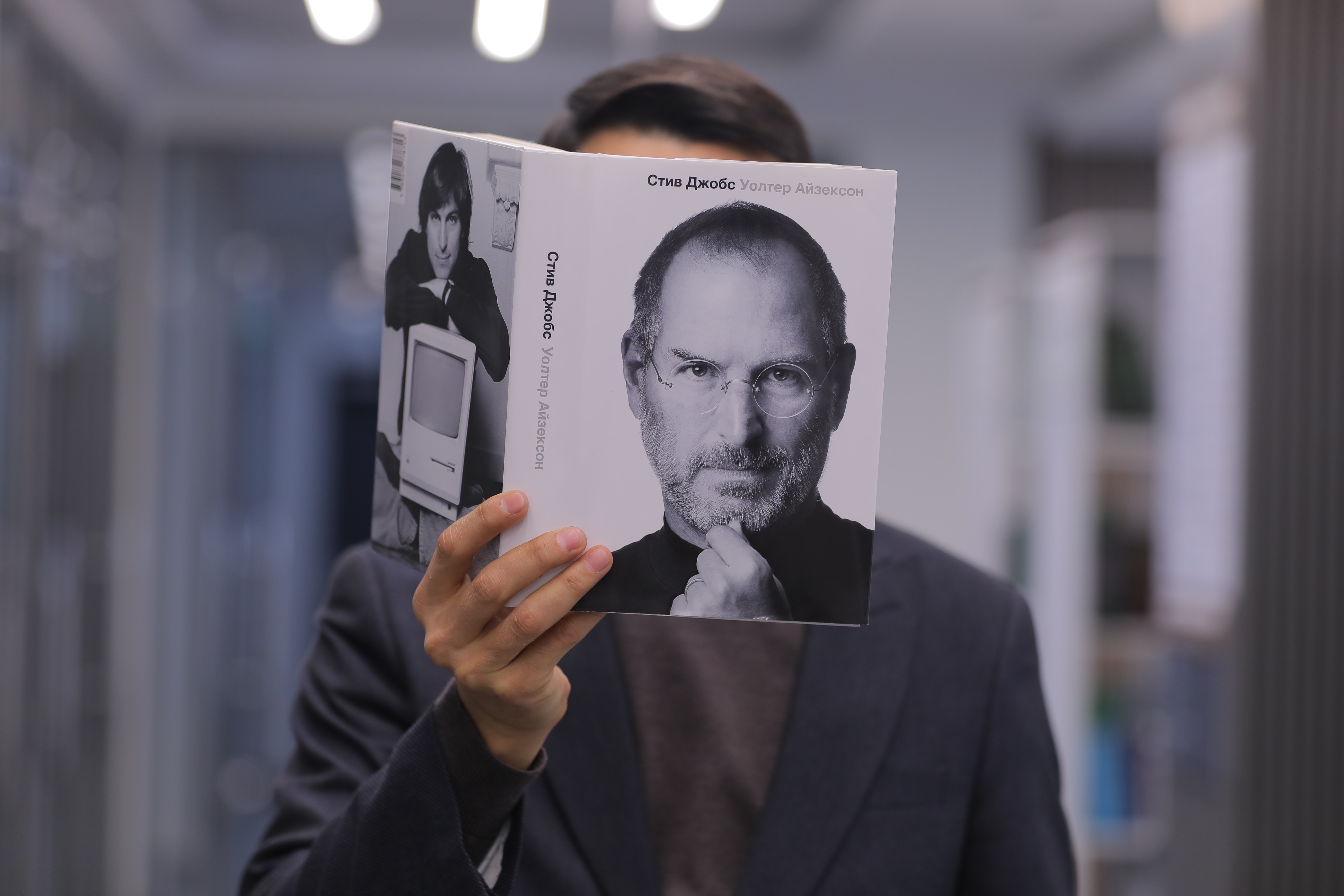
7 LEADERSHIP LESSONS WE CAN LEARN FROM STEVE JOBS
Today we have great opportunities to build perfect organizations for each other by studying and learning from those who already did.
Steve Jobs is one of them. How did He become a great leader? What did He do differently?
He was thinking differently for sure. He was brave enough and dared to go first and show the path that others could follow.
Creating an enduring company with the ability to renew over and over again was more important for him, than “just” creating an awesome product. No one would ever question the groundbreaking importance of the iPhone or the Macintosh and how they shaped many industries, but Steve Jobs’s ultimate success was neither of them.
It was Apple itself.
The campaign to conquer the world started in a garage. With Job’s leadership, Apple achieved to be one of the most innovative companies of our age.
Amongst the many lessons we can learn from Steve Jobs I would like to show you 7 leadership traits I learned from his life that made the story of Apple a success.
#1 Don’t get distracted
In 1997, when Jobs returned to the company after his removal in 1985, Apple was a mess. It was producing twelve different versions of Macintosh computers. Jobs was very disappointed.
To save the company, He only focused on the creation of four great products, instead of mass-producing…not so great products. To satisfy the simple needs of the people He canceled everything else.
Deciding what not to do is as important as deciding what to do. –Steve Jobs
That’s true for companies, and it’s true for products
.
Prioritizing your activities helps you to deal with the important tasks first. The laser-sharp focus is followed by the ability to squeeze the essence out of everything and wipe out the distracting components.
#2 Simplify everything
When Jobs became a college dropout He started to work for Atari, where he learned the true value of simplification. The instruction of Atari’s first Star Trek game was: Insert a quarter and avoid Klingons. That’s it.
It’s so easy to understand that even a drunk college dropout can figure it out.
Jobs' passion for simplicity is discoverable in countless product features.
The fact is, this is the reason you can’t find the On/Off button on the iPod. When you don’t use it, it powers down automatically and powers up when reengaged. Indeed, that button would be useless.
Jobs also hated that mobile phones were hard to handle and figure out how they work, they weren’t user-friendly nor they were good looking, so the iPhone was born.
He believed, that to achieve simplicity they have to integrate the software, hardware, and devices. They wanted to create the perfect user experience.

#3 Say goodbye to your comfort zone
Jobs was well known for how he could push people to the very edge of their capabilities. He’s been loved and hated for this.
A very good example is when he wanted the Mac engineer Larry Kenyon to make the operating system boot up faster. The answer to that is it’s impossible to do that.
Jobs didn’t take that as an answer, so he scratched an equation to show if five million people use a Mac every day and the boot-up takes 10 seconds longer, that equals 100 lifetimes over a year.
Jobs asked, “If it would save someone’s life, could you shave 10 seconds off?”
“Probably I could”, answered Kenyon.
As a result of this conversation, Kenyon cut the boot-up time of the Mac by 28 seconds. Fortunately, no one’s life was in danger.
Impossible is just a word, question everything. You only need to ask the right questions and sometimes that means you have to engage in difficult conversations. That could not happen if you are accepting NO as an answer, which is a pretty good indication of perfectionism.
#4 Excellence above all
One of the essential qualities of Jobs that made Apple such a success is that He demanded to make everything perfect. That was the reason behind the delay of the iPad launch.
It didn’t matter what kind of product He was developing if He felt something was imperfect He would start the process from the very beginning. With the iPad, He went back to the drawing table.
Why?
Because it wasn’t simple enough and didn’t fit in a hand it could slip away. That’s why they made the bottom edge slightly round.
Don’t have any delusions about the cost of this re-engineering, it was very expensive. But it didn’t matter because it wasn’t perfect.
This habit comes from a lesson He learned from His father while they were fixing the fence once. His father told him to take as much care at the back as on the front.
“Nobody will ever know,” Steve said.
“You will know,” his father replied.
So whatever you make, whatever you do, don’t be sloppy. The chances of failure are multiplying in the absence of hard work.
#5 Team up with the best, ditch the rest
He was a perfectionist with the products as with the people. His temper was well known amongst the Apple employees, as his inspiring nature. His passion for the work was infusing the people around him.
Jobs was impatient, brutally honest, and harsh. Some might say an asshole. But He also knew how to generate deep loyalty amongst their employees and loyalty is when people are not letting you down for money and fame.
Those who couldn’t see through His deceptive behavior left the company. The vision and charisma of Jobs were enough to attract those who would help Him realize his dreams, and those were the best. Those, who gave their blood sweat, and tears to make his visions real.
Don’t get this wrong, being rude without knowing how to inspire great people and help them to the peak of their performance is a dumb mistake. Choose wisely, cause there is no single-player mode.
#6 Meet people in real
It’s quite funny to talk about the importance of face-to-face meetings when we are talking about Steve Jobs, a pioneer of the digital era.
He thought that it was insane to communicate via email and chat because the flow of creativity is a result of random meetings and instinctive discussions.
To multiply the chances of these events He designed Pixar’s headquarters with a central atrium where all the corridors, front doors, and main stairs are met.
This way people might run into each other more frequently.

#7 Know the big picture and the small details
Jobs was a master of this principle.
A great example is how He envisioned the computer as a digital hub, a device managing documents, music, videos, photos, etc. These visions led Apple to the creation of the iPad and the iPod.
To manage this incredible amount of data, the company created a huge server farm to move the hub to the cloud.
He was also picky about the color shape of the screws INSIDE! The iMac. Why?
Because, even if you don’t see it, you will know. Just like with the fence.
In October 2011, Jobs passed away at the age of 56, but his lessons are teaching us how to become the best of the best.
He was describing himself as:
“The people who are crazy enough to think they can change the world are the ones who do.”
Leadership is not the privilege of the people sitting at the top. Leadership is like being a parent, you are committed to the well-being of others, making sacrifices for them. It is everyone’s responsibility to be committed to others.
The challenges we face as leaders are more complicated today than ever before and success needs help, only failure can be done alone.
I hope this post inspired you, if you think so, share it with your friends and loved ones.
Thank you for reading, Stay tuned for more.
Kategória
 Communications
 Leadership
 Skill Training